The short-term memory of AI
Shortly after a news event, ChatGPT and others are surprisingly up to date. Five days later, most answers have slipped back to the old state of affairs. Whether an answer is right depends on the source the assistant happens to find.
 Sascha Kirstein
In this article
aclipp is a European PR analytics platform for media monitoring, PR analysis and AI visibility, meaning how brands and topics show up in AI answers. This time we wanted to know how AI assistants handle a news story that moves on within days. For nine days, we asked seven assistants the same twelve questions about the coalition talks between the SPD, the Greens and Die Linke in Berlin. The headline results are in the press release (in German); here we also look at the outlets the assistants cited. The charts are in German; the captions explain them.
Key findings
- Current for a moment, then it fades. Seven hours after the talks concluded, 17 of 19 answers knew the outcome. The day after the next step, 55 percent knew it; five days later, only 39 percent.
- The answer is not fixed. Asked twice on the same day, only one of the two answers mentioned the decision in almost one case in five.
- More coverage does not automatically help. 217 articles were published on the decision. The assistants still mostly cited older ones.
- An answer is only as current as its sources. With an article published after the decision, 84 percent of answers were right; otherwise 33 percent.
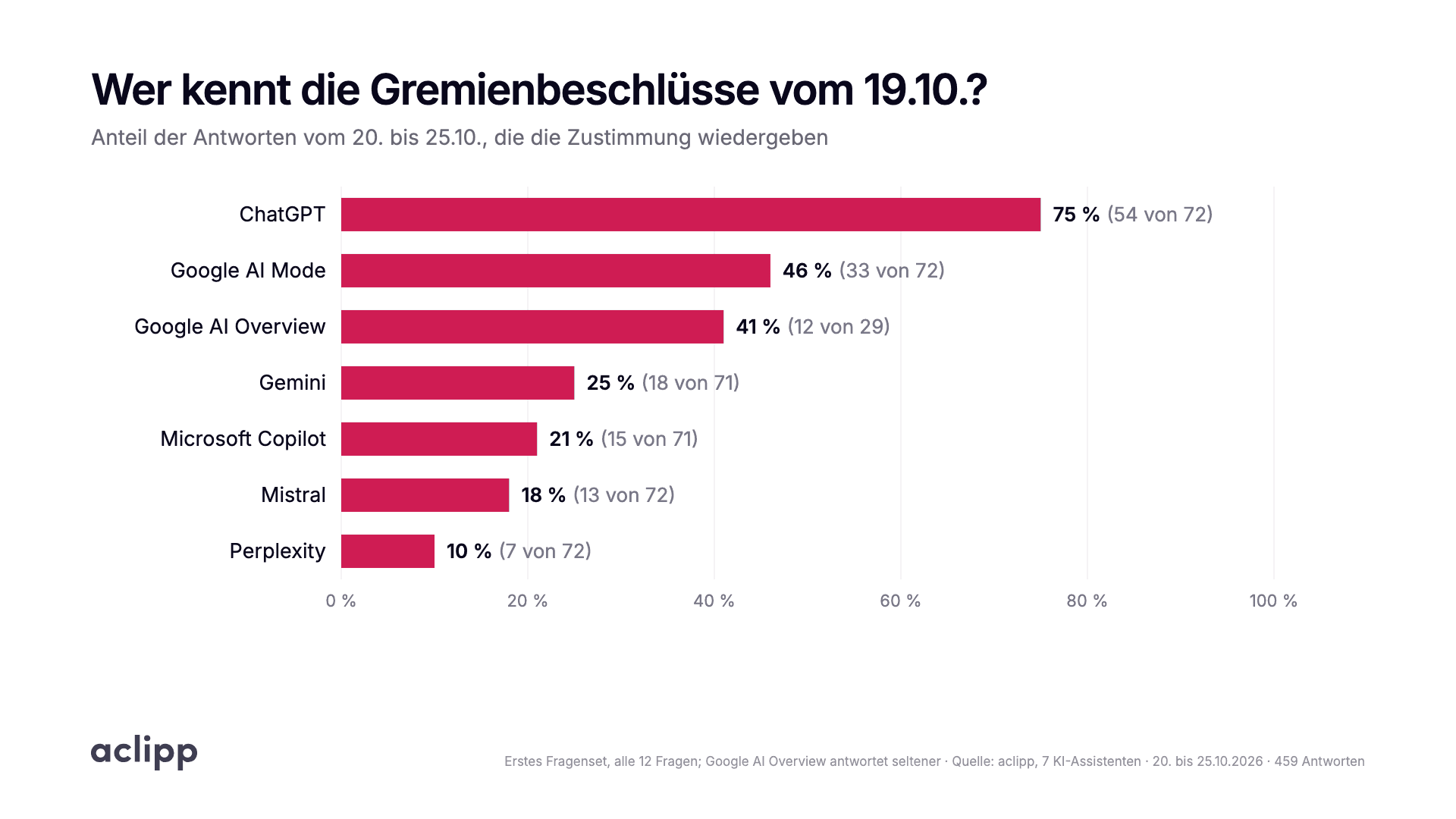
- Each assistant has its regular reads. ChatGPT cites the most recent sources and knows the new state of affairs in three answers out of four, Perplexity in one out of ten.
Current at first, then outdated
Seven hours after the press conference announcing the outcome of the talks on 17 October, 17 of 19 answers reflected it. On 19 October, a Green party conference and the SPD state executive approved coalition negotiations. The next day, only about half of the answers got this new state of affairs right, and it was soon lost again. On 25 October, four in ten answers still described the decision as open.
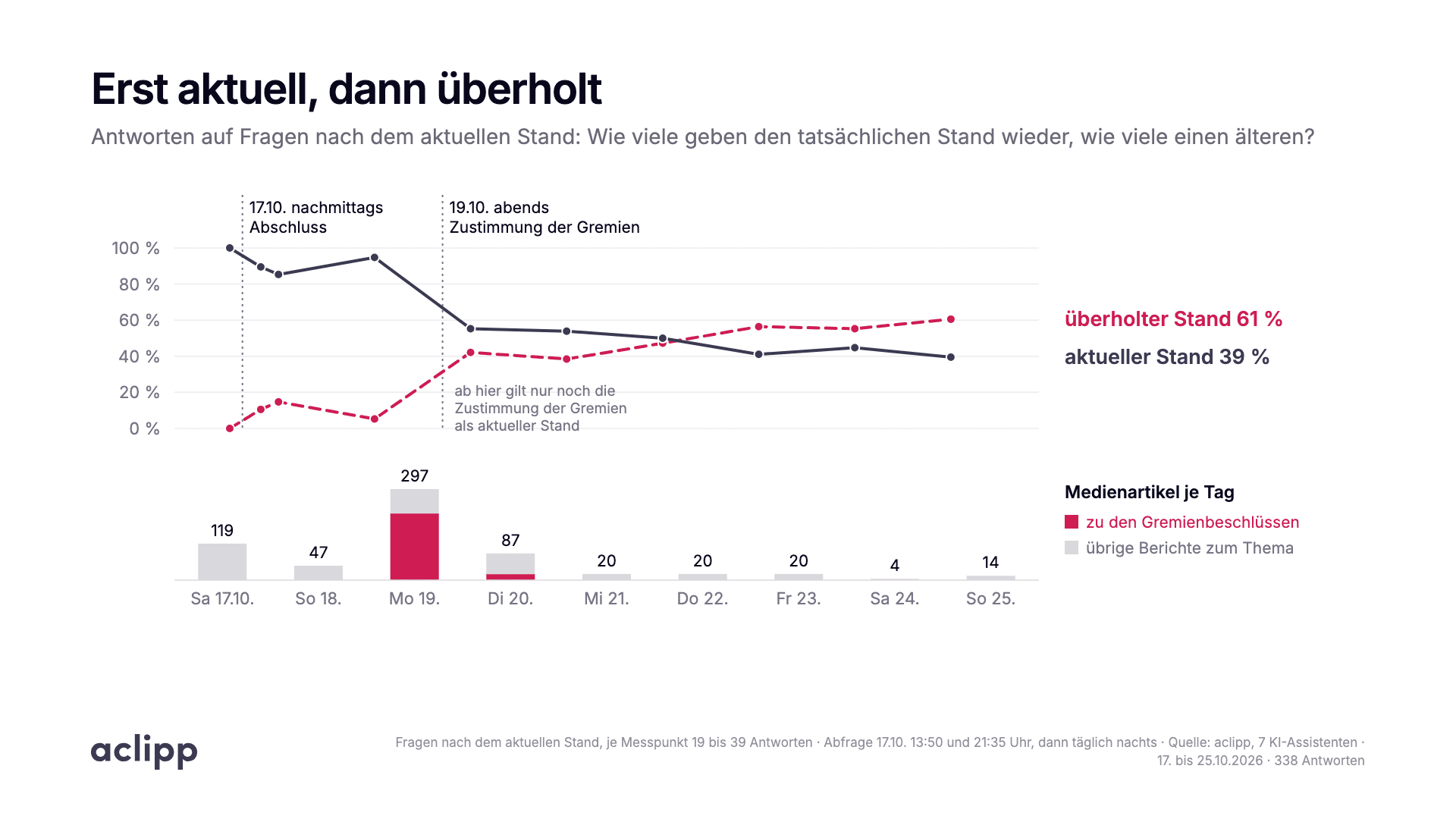
It was not for lack of coverage. On 19 October, 217 articles about the decision were published, including original reporting by tagesschau.de, Deutschlandfunk, SPIEGEL and rbb24. The assistants drew on them too rarely.
An answer is only as current as its sources
AI assistants do not learn a news story; they search afresh for every question. The state of affairs in an answer therefore depends on which article the search happens to return.
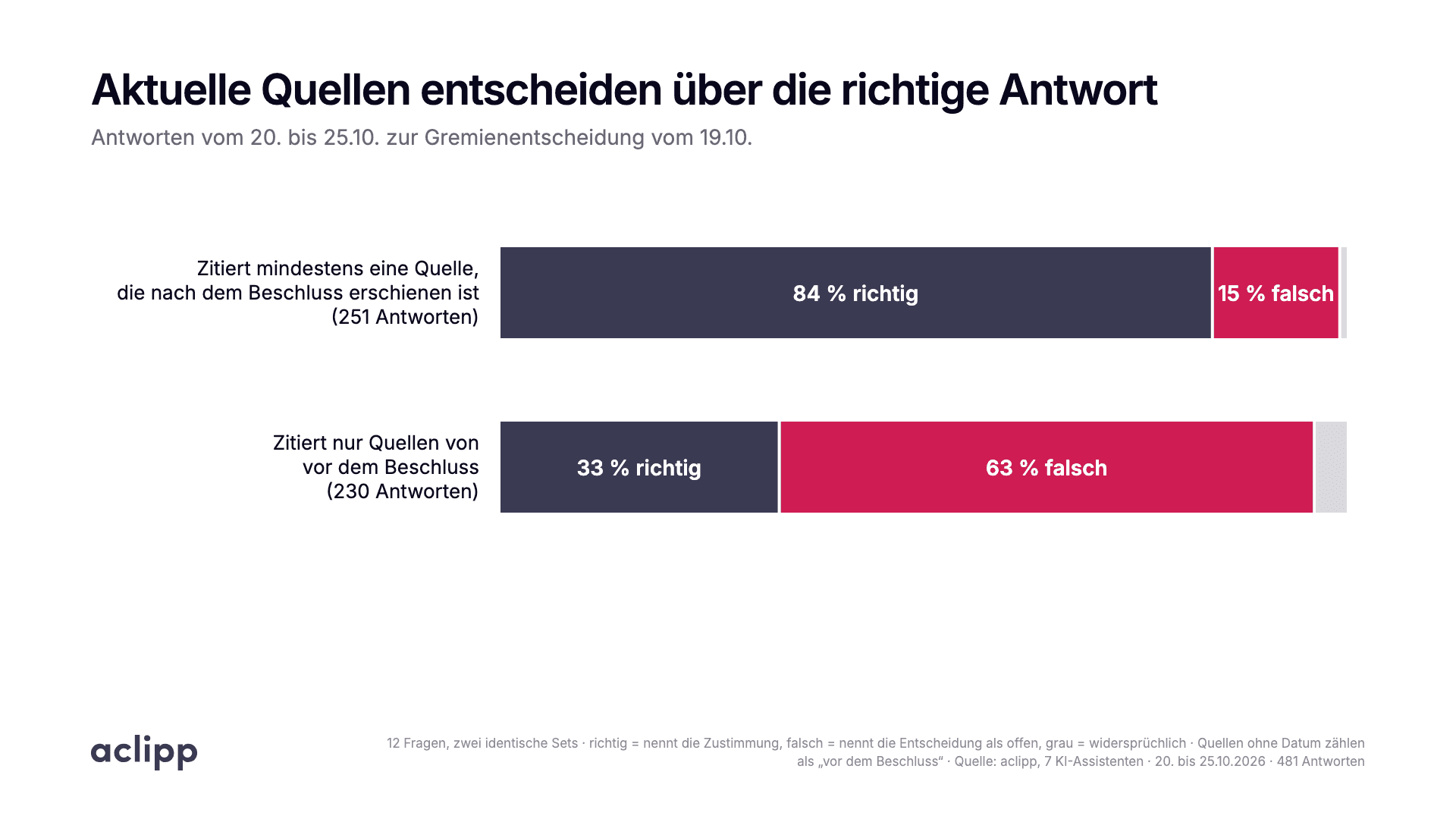
And the search mostly returns the big articles on the outcome. The most cited article of the entire measurement is tagesschau.de's report on the breakthrough in the talks, with 223 citations; tagesschau.de's report on the approval has 23. All reports on the decision combined never exceeded 7 percent of citations, while the articles on the outcome reached 16 to 20 percent every day. A dpa wire story from 27 September was cited more often, through its many republications, than any single report on the decision.
Each assistant has its regular reads
A good fifth of the 4,571 citations went to tagesschau.de, and the share grew over the week: public broadcasters accounted for 35 percent of citations on 17 October and 46 percent on 25 October. Each assistant reads differently, though.
| Assistant | Most cited domain | Share of its citations |
|---|---|---|
| Microsoft Copilot | tagesschau.de | 40 % |
| ChatGPT | tagesschau.de | 38 % |
| Google AI Mode | tagesschau.de | 29 % |
| Google AI Overview | tagesschau.de | 25 % |
| Mistral | rbb24.de | 24 % |
| Gemini | zdfheute.de | 15 % |
| Perplexity | tagesschau.de, tagesspiegel.de | about 13 % each |
20 to 25 October 2026. For Gemini, spiegel.de and zeit.de follow with 14 percent each. For Perplexity only the 50 most cited domains were retrieved, so its shares are slightly overstated.
In the end, these regular reads also shape the quality of the answers. ChatGPT cites the most recent sources and gets the new state of affairs right far more often than the other assistants.
Selective amnesia
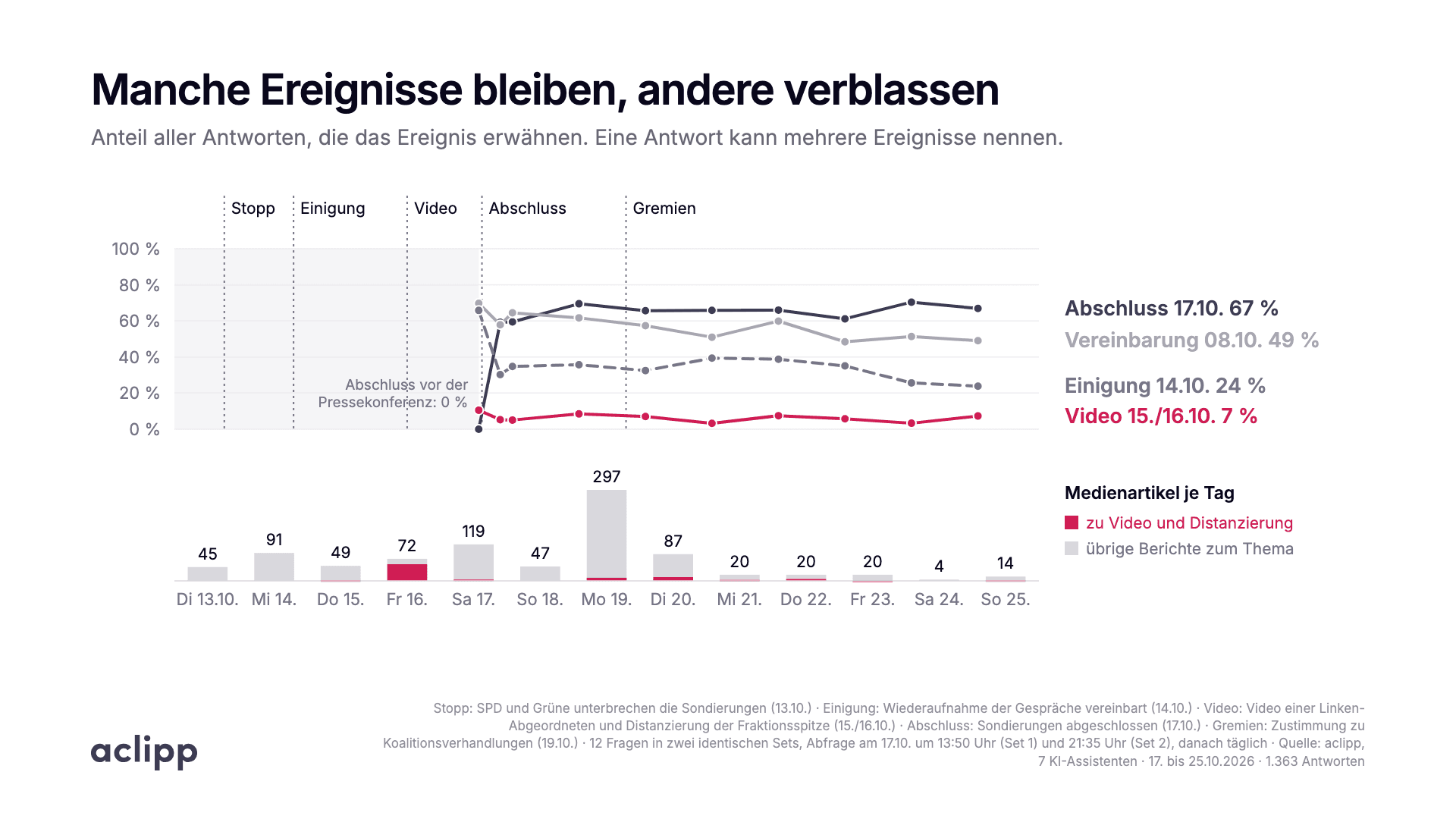
Some events stay, others disappear. Until the end, about two thirds of answers mention the 17 October outcome and about half mention the three parties' agreement of 8 October. Both kept appearing in the background paragraphs of wire stories. A video by a Die Linke member of parliament dominated 54 of 72 media articles on 16 October, yet never exceeded 11 percent of AI answers.
What this means for communications teams
- An announcement is no guarantee. Publishing your news or a correction does not mean AI answers will reflect it. And if they do, they will not necessarily still do so a few days later.
- The cited articles count, not the volume. Which articles the assistants draw on shows in their sources. Being in the most cited report early on probably gives you the biggest head start.
- Background paragraphs and your own page help. What makes it into the recurring background of wire stories lasts longest. And pages of parties and institutions were cited twice as often at the end of the week as at the start. A well-maintained page with the current state of affairs is a lever fully in your hands.
- Measuring once is not enough. Only the trend over several days and several assistants is meaningful.
For newsrooms: if you use an AI assistant to research the current state of a story, check the dates of the cited sources.
Method and limits
- Measurement: Seven assistants, twelve neutral questions in German such as "What is the state of government formation in Berlin?", daily from 17 to 25 October 2026, measured with aclipp from Germany. 1,363 answers and 4,571 cited links in total, compared with 993 media articles.
- Analysis: AI agents (Claude by Anthropic) coded every answer. Of 30 answers we checked by hand, 29 were coded correctly.
- Limits: One news story in one period. The results show patterns, not statistically validated effects. We do not assess any party or person.
All charts, key figures and the breakdown of cited media are available for download with the press release, free to use with credit to "aclipp". If you want to know which sources the assistants draw on for your topics: the GEO Playbook walks you through your own project step by step.