AI Visibility Index Hospitality DACH · November 2026 edition
Recommended today, forgotten tomorrow: ask ChatGPT & Co. twice and you get different hotels
For Gemini and Copilot, only a third of the hotels named overlap from one day to the next. Only 9 percent of hotels appear in all four AI models studied.
Spremberg, Germany, . Travellers increasingly ask ChatGPT and other AI assistants for hotel recommendations. The PR analytics platform aclipp now continuously tracks which hotels they name in its AI Visibility Index Hospitality DACH, covering Germany, Austria and Switzerland. For the first edition, aclipp asked ChatGPT, Microsoft Copilot, Google Gemini and Google AI Overview the same 693 German-language questions about hotels in the three countries on eight measurement days between 3 and 23 November. The 20,687 answers with 95,485 hotel mentions show that the hotels an AI recommends change from day to day. A single look at ChatGPT therefore says little about how visible a hotel really is.
Key facts
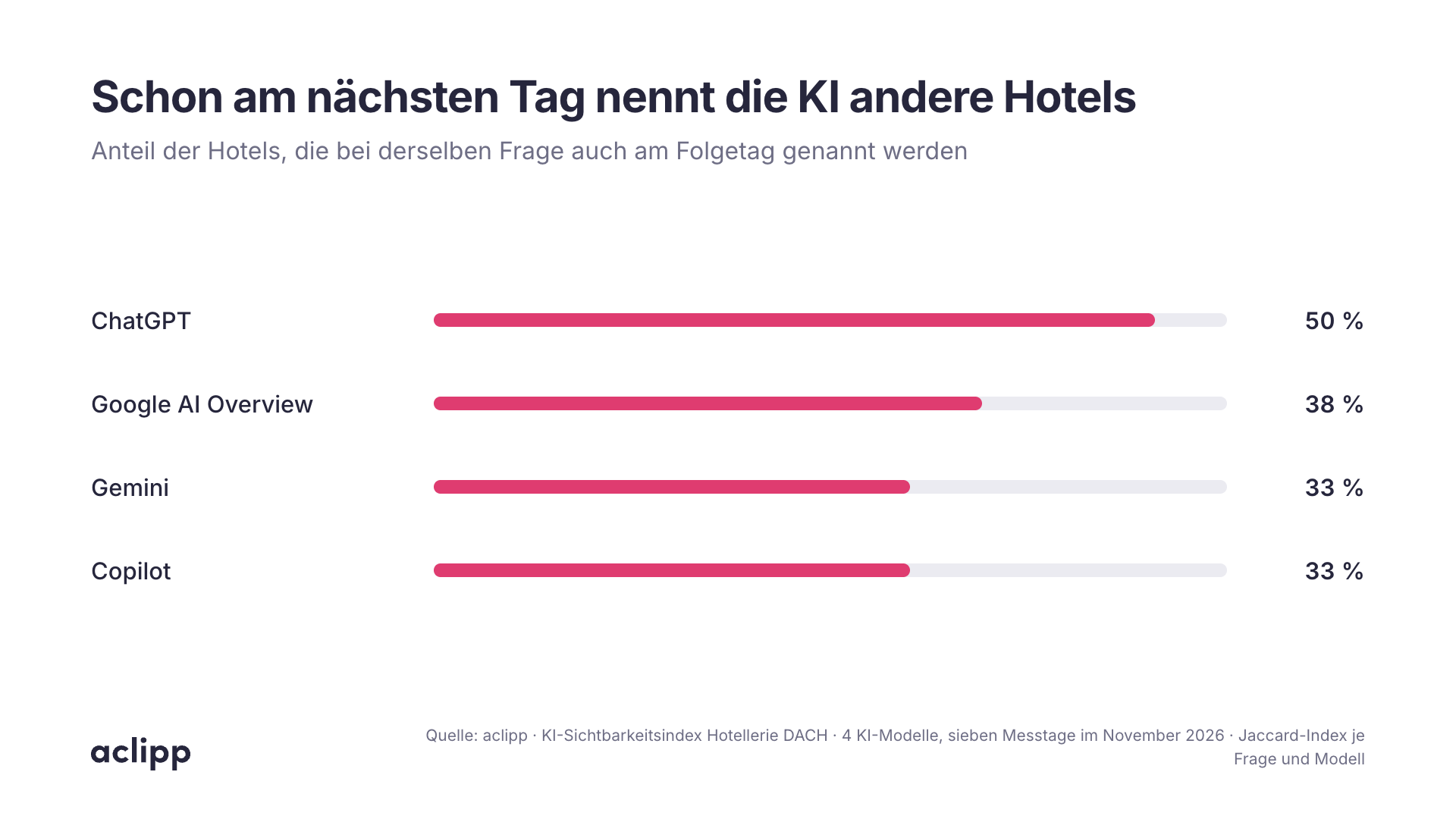
- ChatGPT is the most consistent. From one day to the next, half of the hotels it names are the same (50 percent overlap), compared with 38 percent for Google AI Overview and 33 percent for Gemini and Copilot.
- One in four Gemini answers changes completely. In 25 percent of cases, the answer to the same question shares not a single hotel with the previous day's answer. For ChatGPT, this happens in 4 percent.
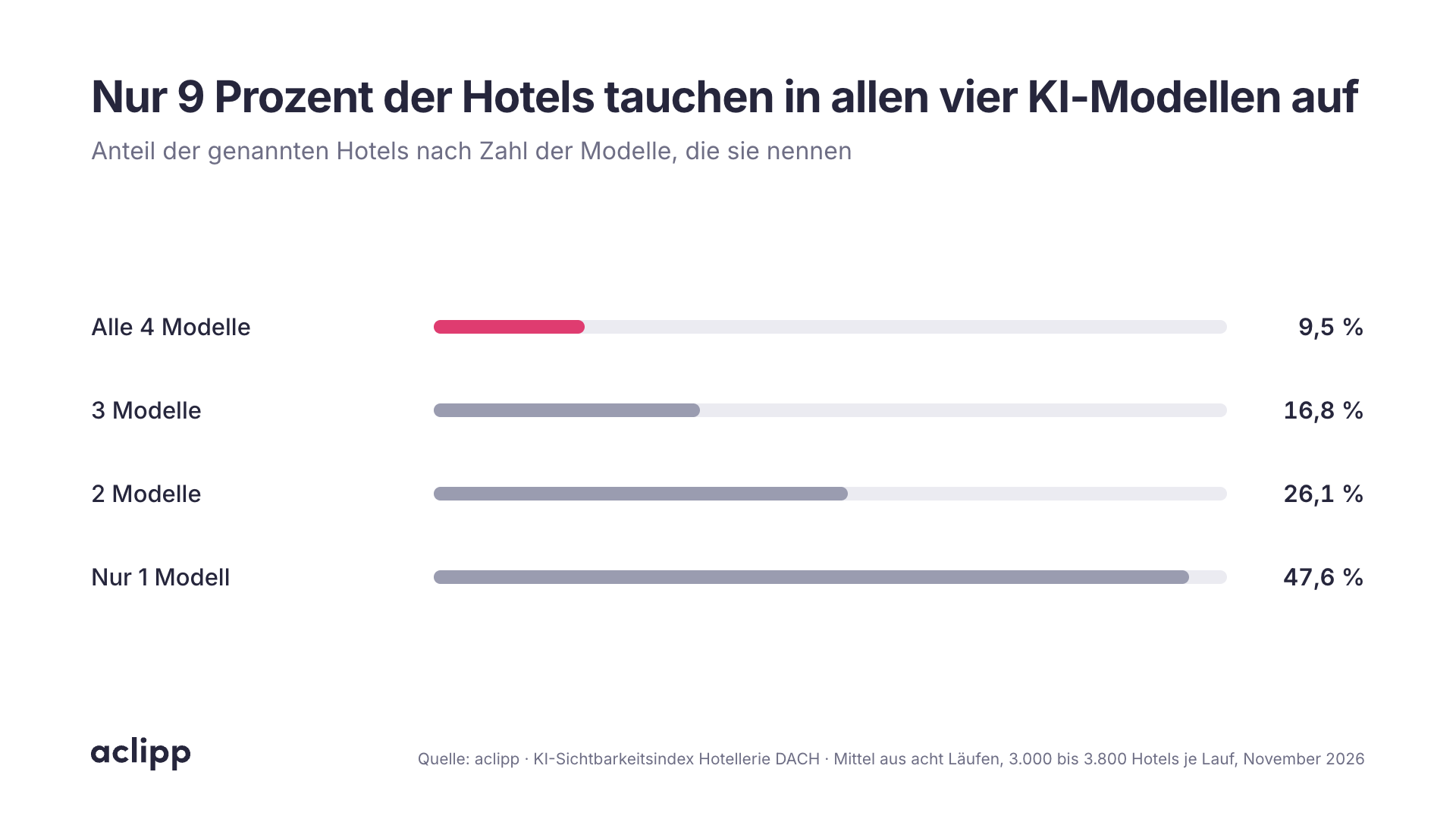
- Each model has its own favourites. 9.5 percent of the hotels named appear in all four models, 47.6 percent in only one.
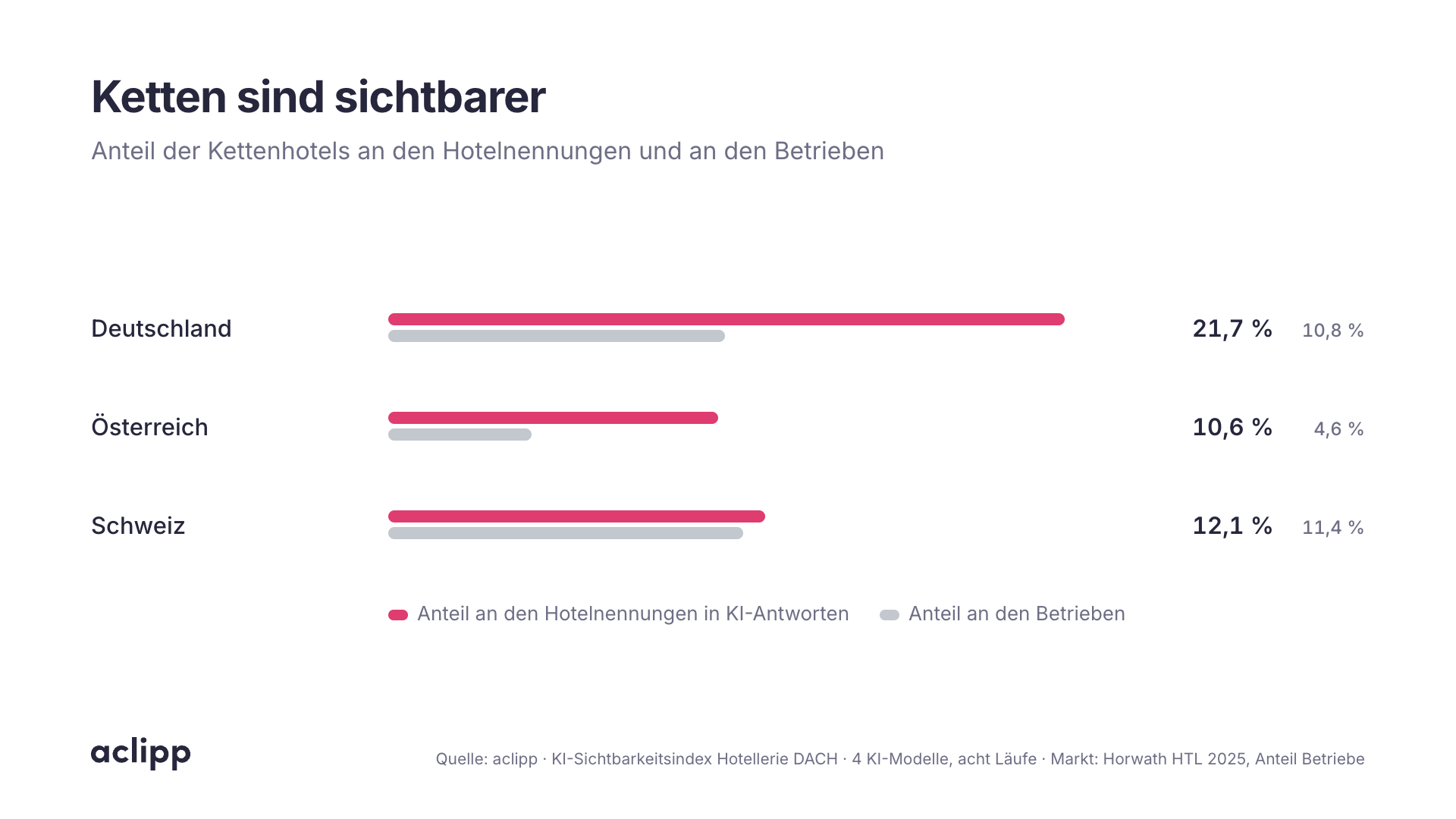
- In Germany, chains are twice as visible as in the market. They receive 21.7 percent of hotel mentions but account for 10.8 percent of properties.
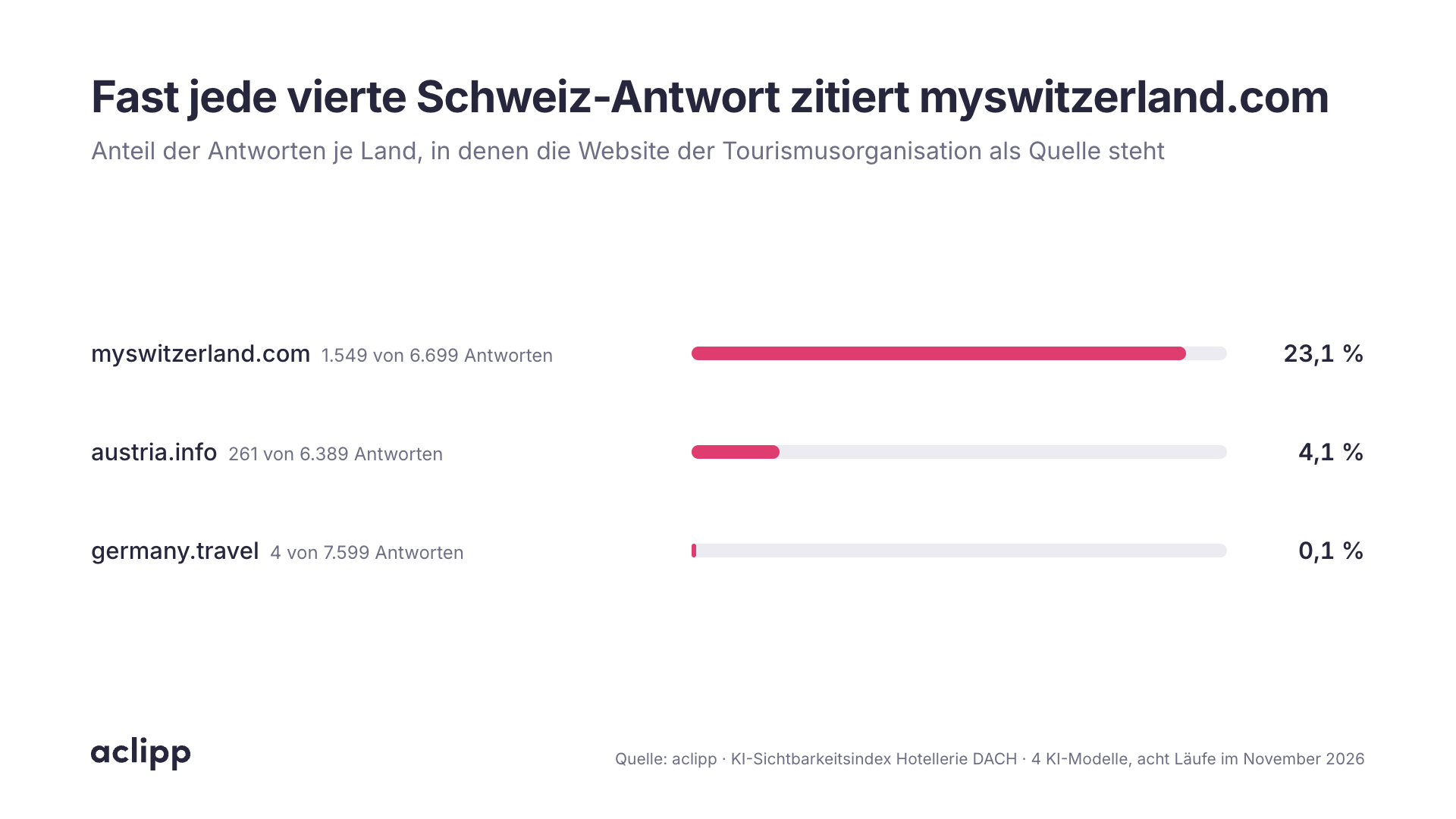
- Switzerland has a lead source. myswitzerland.com is cited in 23 percent of answers about Switzerland, austria.info in 4 percent of answers about Austria, germany.travel in 4 of 7,599 answers about Germany.
A single query is a snapshot
From 18 to 23 November, aclipp asked every question daily to see how consistent the answers are. The measure is the share of all hotels named on two days that appear on both days. For ChatGPT it is around half, for Gemini and Copilot a third (chart 1). The value keeps falling as the gap grows, most clearly for Google AI Overview: from 38 percent after one day to 28 percent after one to two weeks.
| AI model | 1 day apart | 8 to 13 days apart | Next day, no hotel in common |
|---|---|---|---|
| ChatGPT | 50 % | 47 % | 4 % |
| Google AI Overview | 38 % | 28 % | 15 % |
| Gemini | 33 % | 30 % | 25 % |
| Copilot | 33 % | 30 % | 18 % |
Overlap of the hotels named for the same question on two measurement days (Jaccard index), mean over 2,158 to 6,835 question pairs per value. Source: aclipp
"If you check ChatGPT once to see whether your hotel is mentioned, you see a snapshot," says Sascha Kirstein, founder and CEO of aclipp. "Whether a hotel is really visible in AI answers only becomes clear through repeated measurement over many days and across several models."
Each model has its own favourites
Recommendations also differ widely between models. On each measurement day, the four models together name around 3,000 to 3,800 different hotels. On average, only 9.5 percent of them appear in all four models, 16.8 percent in three and 26.1 percent in two. Almost half, 47.6 percent, are named by a single model only (chart 2). A hotel that does well in ChatGPT may be missing from Gemini or Google Search.
Chains and tourism websites shape who gets named
In Germany, 21.7 percent of all hotel mentions go to chain hotels, although according to Horwath HTL chains account for only 10.8 percent of properties. Austria shows a similar pattern (10.6 versus 4.6 percent), while in Switzerland chains are roughly in line with their market share at 12.1 versus 11.4 percent (chart 3). The comparison is with the share of properties, not rooms, because an AI names a hotel once, regardless of its size.
The cited websites show how strongly individual sources shape the answers. Switzerland's national tourism organisation is linked as a source in 23 percent of all answers about Switzerland via myswitzerland.com. austria.info reaches 4 percent in Austria, germany.travel 4 of 7,599 answers in Germany (chart 4). Across all countries, the most frequent hotel sources are booking and review platforms such as Booking.com and Tripadvisor, and hotel guides such as Falstaff and the Michelin Guide.
"The models recommend what they find in their sources," says Kirstein. "Switzerland shows what a destination can achieve when its own website becomes one of those sources. In my conversations with tourism boards at the Tourism Fast Forward conference, however, the topic hardly came up. For hotels and regions alike, visibility in AI answers is currently not a question of advertising budget but of positioning: what do they stand for, and is that written where the models do their research?"
These hotels are among the most visible in AI answers
For country-wide questions, such as the best wellness hotel in Austria, all four models repeatedly name the same hotels at the top. In Germany, Schloss Elmau, Hotel Bareiss in Baiersbronn and Brenners Park-Hotel & Spa in Baden-Baden are among the most visible hotels; in Austria, DAS EDELWEISS Salzburg Mountain Resort in Großarl, Rosewood Schloss Fuschl and DAS.GOLDBERG in Bad Hofgastein; in Switzerland, The Chedi Andermatt, Bürgenstock Hotel & Alpine Spa and Grand Resort Bad Ragaz (charts 5, 6 and 8).
| Country | Hotel | Location | Visibility |
|---|---|---|---|
| Germany | Schloss Elmau | Elmau | 13.5 % |
| Germany | Hotel Bareiss | Baiersbronn | 13.2 % |
| Germany | Brenners Park-Hotel & Spa | Baden-Baden | 8.9 % |
| Austria | DAS EDELWEISS Salzburg Mountain Resort | Großarl | 14.7 % |
| Austria | Rosewood Schloss Fuschl | Hof bei Salzburg | 8.1 % |
| Austria | DAS.GOLDBERG | Bad Hofgastein | 7.2 % |
| Switzerland | The Chedi Andermatt | Andermatt | 14.9 % |
| Switzerland | Bürgenstock Hotel & Alpine Spa | Bürgenstock | 14.3 % |
| Switzerland | Grand Resort Bad Ragaz | Bad Ragaz | 13.8 % |
Visibility: share of answers to country-wide questions in which the hotel is named, averaged across the four models. Base per country and model: 71 to 288 answers. Source: aclipp
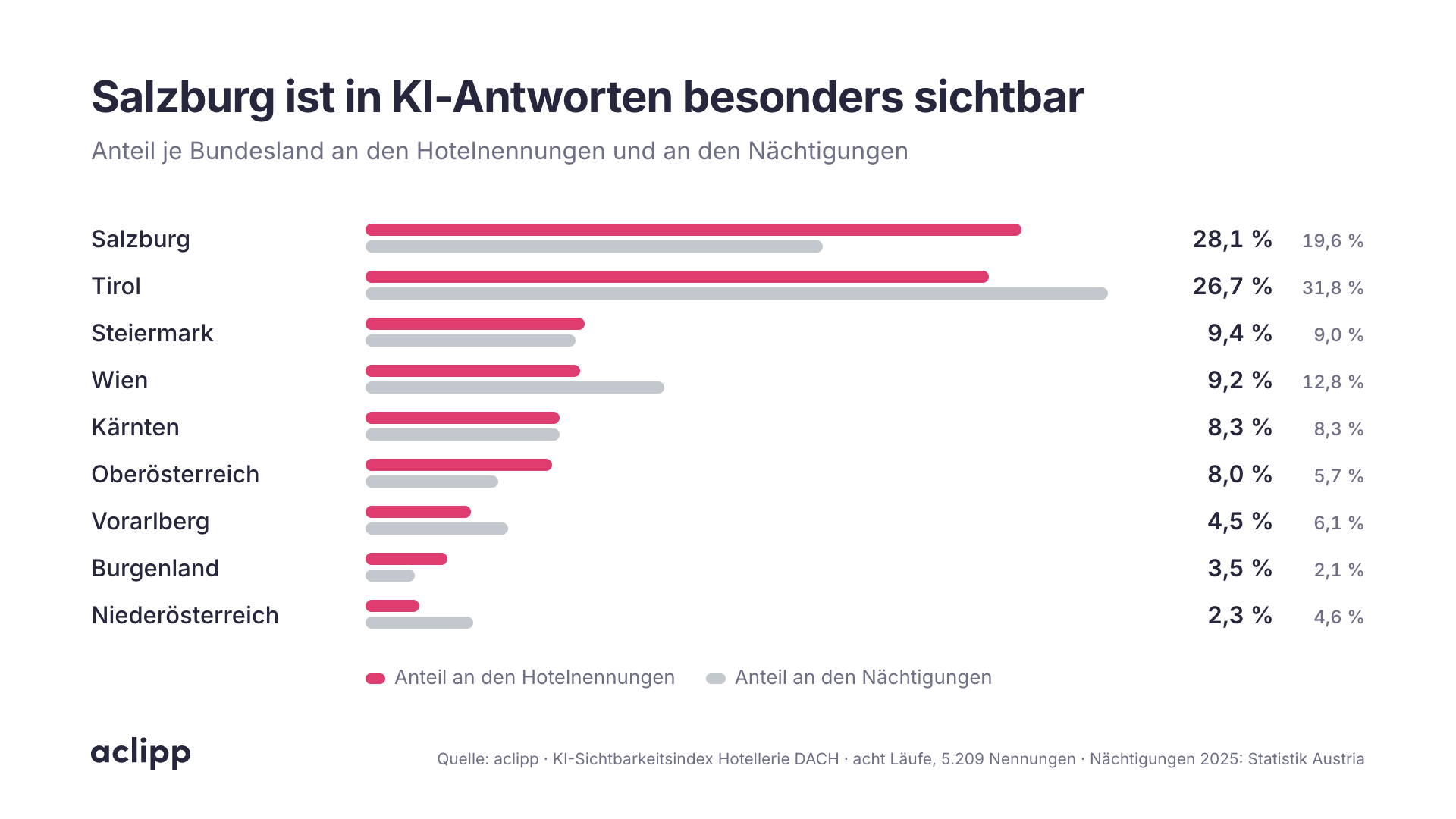
In Austria, the distribution across federal states stands out. Hotels in Salzburg receive 28.1 percent of mentions for Austria-wide questions, although the state accounts for only 19.6 percent of overnight stays. Tyrol, the largest tourism state with 31.8 percent of overnight stays, receives 26.7 percent of mentions (chart 7).
Methodology
- Study: aclipp AI Visibility Index Hospitality DACH, protocol hotellerie-dach-v1.1. Each question asked individually in a new conversation, without follow-up questions.
- Period: eight measurement days, 3 and 10 November and daily from 18 to 23 November 2026. Weekly since then.
- Systems: four AI models: ChatGPT, Microsoft Copilot, Google Gemini and Google AI Overview, queried via their public interfaces. AI Overview does not appear for every search.
- Questions: 693 German-language questions per measurement day (Germany 239, Austria 201, Switzerland 253): country-wide general questions, by theme and by travel situation, and by region and town.
- Data: 20,687 answers, 95,485 hotel mentions, 5,589 uniquely identified hotels.
- Analysis: names matched to hotels via map data and websites. Consistency: Jaccard index of the hotels named per question and model between two measurement days. Rankings: country-wide questions only, share per model, averaged across the four models. Chain affiliation by brand and group names; chains' market share from Horwath HTL, Hotels & Chains Report 2025 (share of properties); overnight stays from Statistics Austria 2025.
- Limitations: 88 percent of mentions are matched to a hotel; only these enter the rankings. Consistency is based on the seven measurement days from 10 November. The index measures whether a hotel is named, not whether it is booked. Some ranking positions are close together; differences of less than one percentage point are not robust.
Charts and data free to use
Charts 1 to 8 (German labels) and the data file with the country rankings (25 hotels each) are in the media kit below. Free for editorial use with the credit "aclipp". The full index is available at aclipp.com/en/hotels/ai-visibility-index.
Links
- Index: rankings for Germany, Austria and Switzerland at aclipp.com/en/hotels/ai-visibility-index
- German version: aclipp.com/de/hotellerie/ki-sichtbarkeitsindex
- Data: country rankings and methodology in the media kit below
About aclipp
aclipp is the European PR analytics platform that helps communications teams and PR agencies prove what their work achieves, in traditional media and in AI answers. Media monitoring, AI visibility (GEO) and reporting in one workspace, built in Germany. Founded in 2020, the founder-led company works with more than 100 agencies and brands across the DACH region and Europe.
Press contact
Sascha Kirstein, Founder and CEO
hello@aclipp.com
High-resolution charts and the full data package are available on request. Sascha Kirstein is available for interviews and background conversations on the methodology.